
Analysis of the health status of male bucks. Development of programmes for elimination and/or prevention of sexually-transmitted infections, which reduce the economic efficiency of goats
Към настоящия момент в България не са разработвани и не съществуват програми за елиминиране и/или превенция на заразни болести предавани по полов път и намаляващи икономическата ефективност на козите. Липсва достатъчна по количество и систематизирана информация по отношение на инфекциозните заболявания по козите. В нашата страна има направени редица проучвания по отношение на тези заболявания, но предприеманите контролно-профилактични мерки са били краткотрайни и несистематизирани. Липсата на контролни мерки, крие неимоверни рискове за трансмисия на вируси при естествено покриване от пръчове или чрез ИО с криоконсервирана семенна течност. Удостоверяването на здравния статус на мъжките разплодници, ще гарантира редуциране до минимум на рисковете от разпространение на инфекциозни заболявания, чрез семенната течност. От епидемиологична гледна точка мъжките разплодници могат да служат за резервоар и разпространител на инфекциозни заболявания. Причините за това са, че тестисите са имуноизолиран орган, където различни патогени (най-вече от вирусно естество) могат да перзистират с месеци. Чрез изпълнение на заложените в проекта дейности ще гарантира благосъстоянието на популациите от кози отглеждани във фермите по отношение на включените заболявания
Highly accurate standardized and fast semen analysis
High-precision CASA / computer-assisted semen analysis / system for standardized, interactive semen analysis. not only provides classical analyzes of motility, concentration and morphology, but also various assessments of sperm function based on fluorescence.
The new generation of CASA Systems used is high-tech equipment that achieves maximum precision in a minimum of time. The system is equipped with a high-speed camera, high resolution and the latest generation of IMX sensors. This sensor provides the system with a very large area for the analyzed field and allows to evaluate up to 1000 sperm. This increases the accuracy and reliability of the results. CASA analysis of the semen sample is extremely fast, reliable and accurate.
Fluorescence analyzes
Samples dyed with specific fluorescent dyes emit light of a specific wavelength or color. The dyes are activated by light of a certain wavelength. Fluorescent dyes stain specific structures of sperm, depending on the integrity and functional state of these structures. These different colors are detected and evaluated by Software. Due to the high speed of analysis, several hundred sperm can be analyzed in a very short time. This state-of-the-art technology has not been used in goat farming worldwide.
Viability
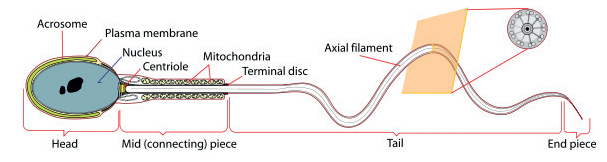
The plasma membrane encases completely the sperm. One of its main functions is that of a protection and the selection of molecules to pass from the outside to the inside. A defect of the plasma membrane can easily lead to the death of the sperm. The viability analysis is mainly used for the quality control of holding samples of fresh semen or thawed samples of frozen semen. A viability test can help to detect fertility problems of individual donor animals or to detect ejaculates of poor quality before the semen delivery, rather than to be faced later with fertility deficiency. The Viability Module offers an automatic count of the percentage of membrane intact sperm, based on a double fluorescence analyze.
Acrosome integrity
The acrosome reaction is a key step for a successful fertilization. It enables the sperm to penetrate the ovum. Prerequisite: an intact plasma and acrosome membrane. Various stressors during semen processing can cause damage to the acrosome membrane or can provoke a premature acrosome reaction. A successful fertilization is then no longer possible. The Acrosome Integrity Module automatically counts the percentage of sperm with damaged acrosome, based on a double stain fluorescence assay.
Mitochondrial activity
The analysis of the mitochondrial activity is a test for the assessment of the energy metabolism of the sperm. The mitochondrial activity is among other things necessary for maintenance of the motility. basic cell functions , and capacitation ability of the sperm capacity (the penultimate stage of mammalian sperm maturation, which makes them able to fertilize the egg). The Mitochondrial activity module offers automated count of percentage of sperm with active mitochondria, based on a double stain.
DNA Integrity
The success of insemination and embryo development is highly dependent on the integrity of the DNA in the sperm. Consequently, the DNA structure can be used to indicate the fertility potential, or to explain sub-fertility, of a certain breeding animal. DNA integrity testing therefore offers a new approach to the clarification of lower fertility rates. The Module DNA Integrity offers the automated count of the percentage of sperm with fragmented DNA based on a special dispersion technique combined with fluorescent staining. This technique detects sperms cells with defective DNA: If the DNA of a sperm cell is fragmented, an aura of light, or halo, will form around the head of the sperm cell. In contrast, all sperm cells that do not exhibit a halo have intact DNA. The halo effect is visible when the sample has been stained with propidium iodide (PI) and exposed to fluorescent light. The percentage of sperm cells with fragmented DNA in a given ejaculate or sample can thus be determined.
Генетична банка от замразена сперма и ембриони
В изпълнение на поставените целите Оперативна група за иновации в козевъдството ще създаде генетична банка от замразена сперма и ембриони, които могат да се използват в случай на тежки епизоотични ситуации или катаклизми за възстановяване на популацията от млечни кози в България. Тук иновацията е използването на замразени ембриони, които са носители на целия генетичен прогрес на двамата родители. При използване на този метод за ex-situ съхранение на генетични ресурси, могат да бъдат възстановени след пълно унищожение популации само за едно поколение след ембриотрансфер в сурогатна майка /5 месеца колкото трае бременността/, за разлика от използването само на съхранена замразена семенна течност, от която няма да се възстановят напълно изгубените гени и процесът ще отнеме над 5 години.